
.svg)


Structural Connector Testing at a Glance
A joist hanger or hurricane tie may look simple, but one weak link can bring a floor or roof down.
That is why every new connector must undergo rigorous structural testing before it reaches a job site. Accredited labs conduct comprehensive evaluations, compiling results into an ICC-ESR report that building officials use as proof of safety (ICC-ES timeline).
Because these results carry such weight, independent, ISO-accredited labs add a vital layer of trust. Their “no-skin-in-the-game” status removes bias and gives architects, insurers, and code officials confidence in the numbers.
Key Points
- Start with low-cost Engineering Validation Tests (EVT) in an ISO/IEC-17025 lab to spot design flaws early. This can avoid 10× re-test costs later and gives architects and officials unbiased data.
- Full certification moves from EVT to DVT and PVT, where representative samples are tested to ASTM D7147 (loads) and ICC-ES AC13 (code compliance), with additional testing to ASTM B117 (corrosion) and UL 263/1479 (fire) as required for specific products and markets, before any product can be sold.
- Published connector capacities equal the lowest of ultimate failure, 1/8-inch slip, or NDS math—then divided by a 3.0 safety factor—to prevent overrating even if test materials are extra strong.
- Quality doesn’t stop at the lab: random AQL lot sampling, NIST-traceable calibrations, and 1–2 ICC-ES plant audits per year keep production output aligned with the certified design.
- Plan on 18–24 months for the full ICC-ESR process; pre-approved test matrices, complete traceability paperwork, and budgeted re-test time speed up approval and unlock hassle-free permit acceptance.
From Prototype to Proof
New structural connectors progress through three key build stages that transform an idea into certified performance data.
- Engineering Validation Test (EVT): Teams produce an initial batch of functional prototypes, typically ranging from 10 to several hundred units depending on complexity. Early testing at this stage helps identify obvious failure modes, such as torn flanges or split lumber, through targeted pre-compliance checks
- Design Validation Test (DVT): Production tools are used to build dozens to a few hundred units for comprehensive testing and validation. At this stage, labs repeat structural connector testing under the full ASTM D7147 and ICC-ES AC13 rules. Early DVT wins let engineers lock geometry before hard tooling.
- Production Validation Test (PVT): More than 500 units roll off real production lines while accredited labs witness runs, confirm process controls, and collect final data for the ICC-ESR file.
Running a $3,000 pre-compliance test at EVT can prevent a $30,000 re-test later if the connector fails under accredited conditions.
Viewed another way, early testing often pays for itself. Catching a cracked flange, misaligned nail hole, or weak weld during EVT can prevent full DVT re-runs that cost ten times more. Small, controlled failures early protect budgets and schedules later.
The lesson is simple: fail fast with inexpensive samples, then pass once when the stakes rise.
Key Connector Testing Standards Decoded
Each connector testing standard serves a distinct purpose, together forming the foundation of credible lab validation.
- ASTM D7147 is the backbone for wood-to-wood connectors. It defines sample preparation methods and limits the loading ram speed to between 0.03 and 0.2 inches per minute to avoid false strength spikes.
- ICC-ES AC13 adds field realism through random lot sampling, specific rafter-to-plate boundary conditions for hurricane ties, and mandatory staff approval of each test matrix .
- ASTM B117 governs corrosion testing. Samples face a 5% salt fog at 95 °F – often for 1,000 hours or more – to evaluate coating durability.
- UL 263 and UL 1479 address fire performance. These furnace tests expose assemblies to time–temperature curves that mimic real fires, verifying that the connector maintains integrity until the wall or beam fails.
- ISO/IEC 17025 accreditation demonstrates a lab’s technical competence. It covers technician training, calibration systems, and quality management – helping accredited labs gain broader recognition for their results, though local or customer-specific rules may still apply.
Together, these standards form the rulebook every credible testing lab must follow to validate structural connectors and fasteners.
Calculating Allowable Loads the Lab Way
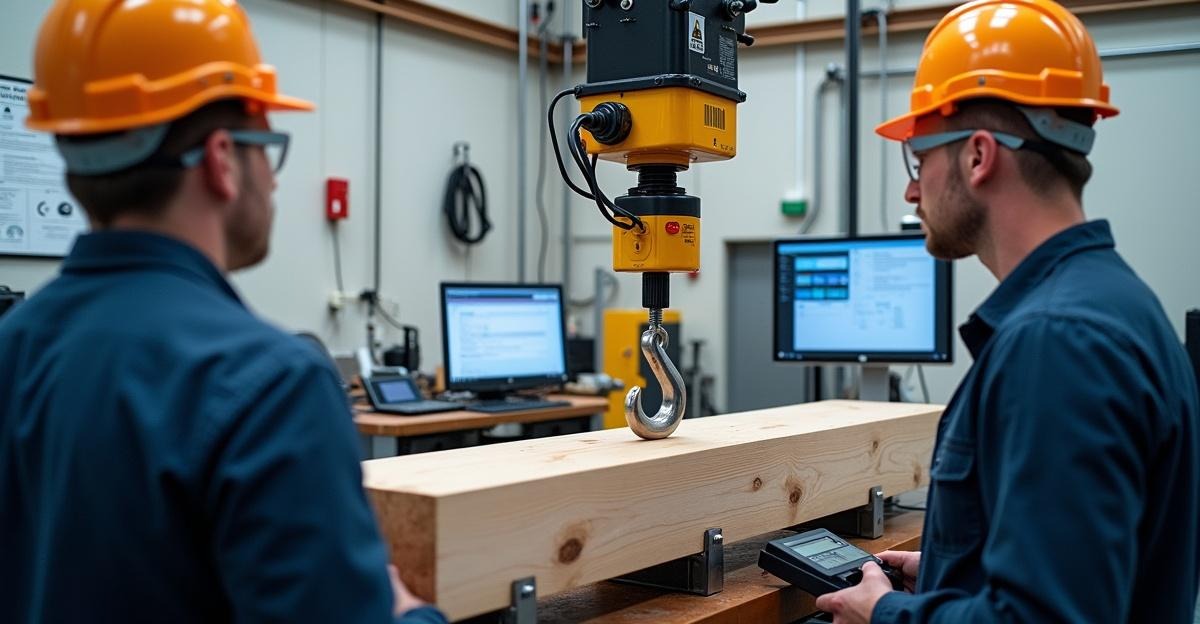
Labs record three key numbers during each pull test:
- Ultimate load at failure
- Load where the joist slips 1/8 inch
- Load from National Design Specification (NDS) math for nail shear and wood bearing
The smallest of the three is divided by a safety factor of 3 to set the published capacity.
Example: A hanger fails at 9,000 lb, slips 1/8 inch at 7,800 lb, and the NDS calc gives 8,100 lb. The 7,800 lb controls. After the factor of 3, the allowable load is 2,600 lb.
If the test steel or lumber is stronger than the specified grade, ASTM D7147 allows reviewers to adjust results downward so real-world parts are not overrated.
This adjustment keeps published tables realistic and credible.
Beyond Load: Corrosion and Fire Evaluations
Moisture, salt, and fire continue to challenge connectors long after construction ends.
To ensure long-term reliability, labs perform additional tests that evaluate coating durability and fire resistance.
- Corrosion testing (ASTM B117): Samples are exposed to a 5% sodium chloride fog at 95 °F for 1,000–1,500 hours. The appearance of red rust before the time limit indicates coating failure. Cyclic methods like ASTM G85 add dry periods to better replicate coastal conditions.
- Fire testing (UL 263 or UL 1479): Connectors are bolted into wood or steel frames and subjected to the UL 263 furnace curve. The assembly must retain its load until the code-mandated time mark. Common failure modes include nail withdrawal after charring and sheet-steel softening.
Corrosion and fire results often determine market eligibility for coastal, chemically treated lumber, and multi-family projects.
Skipping these evaluations can lead to field callbacks, rust damage, or costly delays if a fire marshal requests proof of compliance.
Quality Control: Sampling, Traceability, and Plant Audits
A single strong test means little if factory output drifts over time.
Quality control ensures that every production batch continues to meet certified performance standards.
- Lot sampling (AQL): Labs and inspectors use Acceptable Quality Limit (AQL) tables to select random pieces from each lot. An AQL of 1.0% defines a statistical threshold for accepting production batches, helping ensure most meet quality requirements—though it does not guarantee only one defective part in 100 will escape into shipments, nor does it set a strict maximum defect rate in every sample.
- Measurement traceability (NIST): Every tool used in the testing chain must link back to the National Institute of Standards and Technology. This NIST traceability creates an unbroken calibration ladder and defines the uncertainty at each step (NIST traceability).
- Plant audits (ICC-ES AC-10): ICC-ES inspectors visit manufacturing plants at least annually to verify quality systems, material certifications, and corrective actions, ensuring ongoing compliance with certified standards.
- Witness testing: On high-risk or high-value projects, firms may send a neutral third-party witness to the lab. The witness verifies fixtures, observes procedures, and files an independent record that can stand up in court.
Together, these checks confirm that certified connector performance isn’t just proven once in a lab – it’s reproduced consistently on the factory floor.
Conclusion
Structural connector testing is more than a code hurdle.
It is proof that a small steel part can carry life-safety loads through wind, rain, and fire. Independent, accredited laboratories backed by tight sampling plans, NIST-traceable tools, and rigorous audits turn raw test data into market passports like the ICC-ESR.
Companies that engage these labs early transform testing from a last-minute scramble into a strategic advantage, clearing the path for faster approvals, wider adoption, and scalable growth.
The result is not just compliance.
It’s a measurable reputation boost with specifiers, inspectors, and end users who value verified performance.