.svg)


Utility-scale solar parks are now a major source of new power on the grid—and they’re built and operated more like conventional power plants than rooftop solar.
For developers, utilities, investors, and energy buyers, understanding how these projects get approved, financed, and run matters because small missteps in siting, interconnection, or compliance with solar panel regulations can delay commercial operation date (COD) and erode returns.
This guide explains how solar parks work at a plant level, how teams choose viable sites, how projects are financed and sold (power purchase agreement (PPA) vs merchant), and what the real development timeline looks like from early studies to commissioning. You’ll also see notable examples and where the next wave is headed, including solar+storage hybrids and more data-driven operations.
If you’re evaluating, building, financing, or advising on a utility-scale project, this article is designed to help you spot the drivers of performance, bankability, and scalable execution—without getting lost in generic solar basics.
Key Points
- Solar parks are utility-scale photovoltaic (PV) plants (≥1 MW) that feed power into the grid using substation-level controls and revenue-grade meters—distinct from rooftop or community solar that serve on-site or subscriber loads.
- Project success hinges on early site and grid vetting: strong solar resource, manageable land and civil work, and a short, viable interconnection path can cut costs, speed permits, and improve capacity factor.
- The core hardware chain—modules, trackers or fixed tilt, inverters, medium-voltage (MV) collection, a step-up substation, and a plant controller—must meet strict safety and power-quality requirements; monitoring and planned operations and maintenance (O&M) protect long-term output.
- Financing typically pairs long-term PPAs (or merchant sales) with a capital stack of sponsor equity, tax incentives, and project debt; bankability improves with creditworthy offtakers, conservative energy models, and documented compliance.
- Development follows gated phases (feasibility, interconnection, permitting, procurement, construction, commissioning), with delays most often tied to grid queues and equipment lead times; the future points to PV+storage hybrids, standardized blocks, and more analytics-driven operations.
Solar Park: An Overview
A 1 MW solar park can produce enough electricity to power about 400 to 900 homes in a year, and its output flows into the utility grid for others to use.
That scale makes it different from rooftop solar, which primarily serves the building it sits on. In practice, a solar park looks and operates like a power plant—just without fuel combustion.
A solar park is a utility-scale, grid-connected PV power station of at least 1 MW that sells power into the grid through a substation and utility meters.
“Utility-scale solar, also known as grid-scale solar, refers to massive PV facilities designed to feed power directly into the electric transmission grid.” That framing captures the central idea of a large, centralized generator that serves many customers at once and sits within the power system’s control and protection rules.
Compared with distributed solar, the difference is mainly operational.
Residential and commercial systems generate on-site for immediate use, often with a bidirectional meter.
Solar parks generate at scale for the wholesale grid, with plant-level controls, revenue metering, and utility inspections that govern when they can operate. Those controls and meters are not optional. They are the path to permission to operate and to bankability.
Capacity thresholds vary by source. Some define utility-scale starting at 1 MW, while National Renewable Energy Laboratory (NREL) often sets the bar at 5 MW.
In practice, most parks fall well above that.
Grid-scale facilities also account for a large share of solar’s footprint today, supplying roughly 60% of total solar capacity.
Solar Parks vs Rooftops
Solar projects generally fall into three buckets:
- Utility-scale solar parks
- Rooftop distributed systems
- Community solar.
Solar parks are centralized generation.Rooftop and community solar are distributed generation tied to specific buildings or subscribers. The differences below show how these models diverge in scale, ownership, grid connection, revenue structure, and siting requirements.
- Size and scale: Solar parks are typically larger than 1 MW and often span 5 MW to 100+ MW, while rooftop systems range from a few kilowatts to a few hundred kilowatts.
- Ownership and offtaker: Solar parks are built by developers, independent power producers, or utilities and sell electricity to an offtaker, such as a utility or large company. Rooftops are owned by the site host or a third party serving the host load. Community projects are developed for groups of subscribers organized by a utility program or a third-party administrator.
- Interconnection path: Solar parks connect through a substation at medium or high voltage and follow grid operator rules. Rooftops interconnect on the distribution feeder at the building’s service panel. Community projects interconnect on distribution lines and serve bill subscribers through utility programs.
- Energy delivery: Solar parks sell wholesale energy under a PPA or into a market. Rooftops offset on-site use first and then export surplus if allowed. Community projects allocate shares of a central array to subscribers through bill credits.
- Metering: Solar parks use revenue-grade meters and plant controls at the substation. Rooftops use a site meter that can flow power both ways. Community projects meter plant output and apply credits to subscriber accounts.
- Siting constraints: Solar parks need open land with good sun and access to transmission. Rooftops must fit the host’s roof geometry, structure, and shading. Community projects balance land availability with proximity to distribution capacity.
Developers choose the utility-scale approach for scale, long-term price certainty, and a grid role closer to a conventional plant.
Plant-level systems such as a power plant controller regulate voltage and ramp rates to meet utility requirements under IEEE 1547. Paired with revenue metering, these controls help parks deliver predictable output and integrate into dispatch.
Rooftop systems reduce a building’s bill by making power on-site, while community solar can extend access through bill credits from a shared array.
These models can coexist in the same region, each serving a different need.
Inside a Photovoltaic Power Station
A utility-scale solar park delivers grid-ready electricity through a coordinated plant architecture—from field-level direct current (DC) collection and inverters to MV collection and a substation that serves as the grid-facing interface.
Core Energy Flow (Modules to Substation)
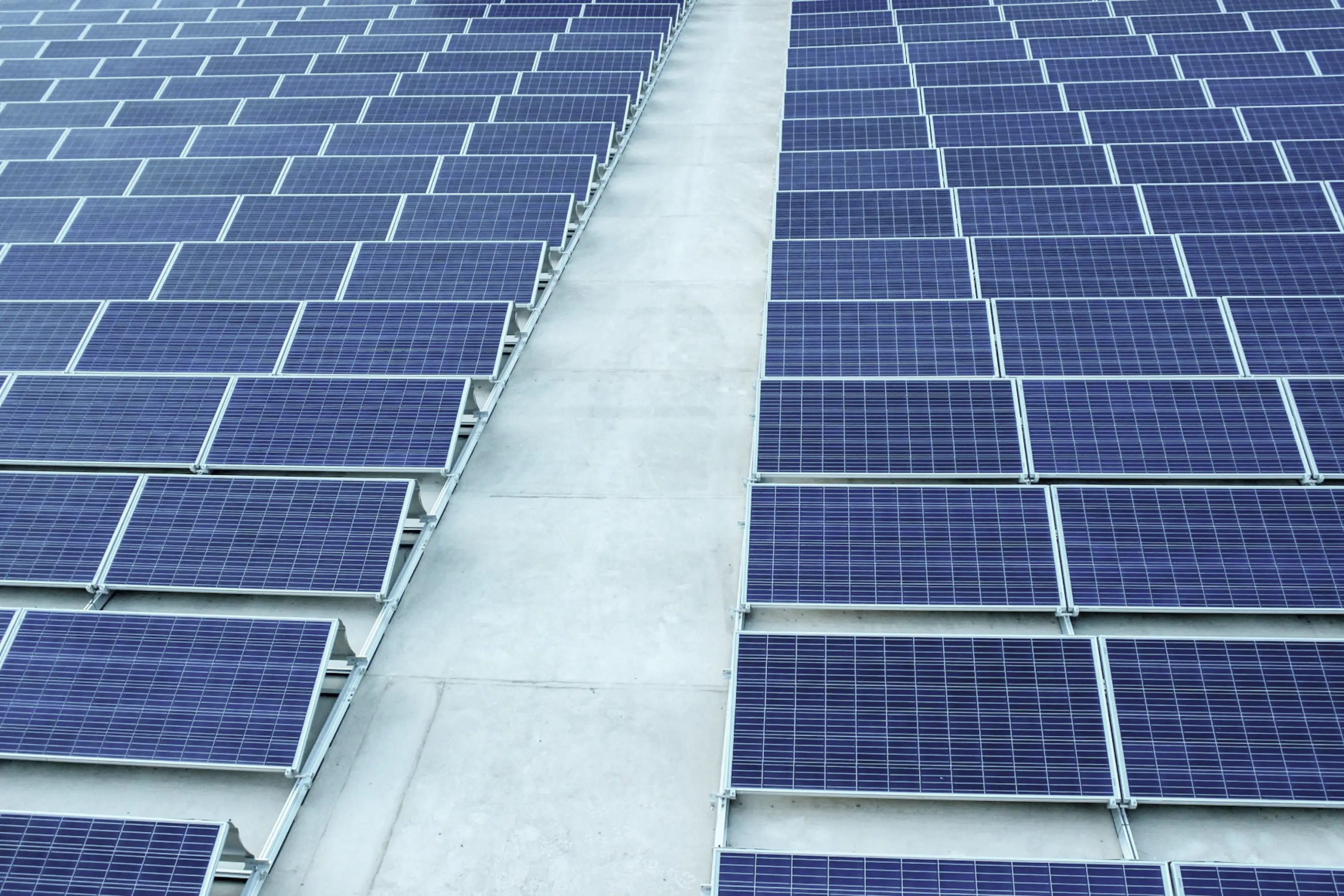
It starts with PV modules, often called solar panels (see solar panels facts). Modules are wired into strings, then gathered in combiner boxes that protect circuits and feed power forward as DC.
At a high level, a utility-scale solar park moves power through these core blocks:
- PV modules → strings → combiner boxes (DC collection)
- Inverters (DC to AC conversion)
- MV collection system → step-up transformers
- Substation (grid intertie, metering, and controls)
Panels sit on mounting structures designed to handle wind and weather.
Some sites use single-axis or dual-axis trackers that follow the sun to boost yield, trading higher energy for more moving parts and stronger foundations in higher-wind areas.
Inverters convert DC to alternating current (AC) that matches grid frequency and voltage. Utility-scale plants use either many string inverters spread across the site or a few central inverters in equipment pads. String designs add redundancy and finer monitoring.
Central designs can simplify MV collection and service work.
From the inverters, MV cables carry power to step-up transformers. A substation raises voltage for the transmission system and serves as the park’s grid-facing interface.
Controls, Monitoring, and Safety
A power plant controller coordinates active and reactive power so the plant behaves like one unit on the grid. Quality and accountability depend on measurement at several points.
- Plant controller: coordinates active and reactive power so the park operates as a single grid resource
- Revenue metering: records delivered energy for billing and settlement
- Power quality metering: confirms voltage, frequency, and harmonics meet utility specs, which is a condition for permission to operate
- Data acquisition system (DAS) + met stations: link equipment status to global horizontal irradiance (GHI) and plane-of-array irradiance (POA), temperature, wind, and soiling to explain performance and support predictive maintenance
- Safety hardware: grounding, surge protection, and overcurrent devices that reduce fire and shock risk before energization (see NEC 2023)
Design is a series of practical tradeoffs.
Trackers can lift output on high-irradiance, flat land. Fixed-tilt can fit complex terrain with lower mechanical risk. String inverters can isolate faults to small zones, while central inverters can simplify the MV layout.
Independent advisors and cloud-based tools help teams test these options in software, verify conformance with utility expectations, and document choices early.
That front-loaded diligence reduces redesigns, supports safe commissioning, and builds trust with the interconnecting utility.
Solar Park Site Selection
Site selection for solar parks decides more than a map pin. It sets the ceiling for energy yield, the cost of interconnection, and the speed of approvals.
The same plant controller and metering described earlier work best when the site supports stable output and clear grid access.
Energy Yield and Buildability
Developers start with solar resources and constructability, because those factors set the baseline for modeled output and installed cost.
- Solar resource: GHI and POA data drive energy models and capacity factor assumptions; climate, haze, and horizon openness affect production.
- Shading and setbacks: trees, structures, and required buffers shape layout; row and tracker spacing balance shading losses with land efficiency and airflow for cooling.
- Slope and soil: gentler grades reduce earthwork; variable terrain often pushes multi-area zoning; soil bearing and corrosivity affect pile design and coatings.
- Land efficiency: footprint per MW depends on module efficiency, spacing, and trackers, and has improved as modules and tracker designs have advanced.
Grid Access and Approvals
Even strong sites can stall if grid access or permitting is weak, so teams screen interconnection and approvals early.
- Proximity to transmission/substations: shorter gen-tie lines and clearer rights-of-way reduce cost and schedule risk.
- Interconnection path: studies determine upgrades and queue timing; in many regions, queue position is a critical driver of COD.
- Logistics: access roads must support heavy deliveries (transformers, substation gear) and peak installation activity, which can involve 100+ workers on site.
- Environmental and local requirements: stormwater, erosion control, re-seeding, vegetation management, and decommissioning plans are often core permit artifacts—not add-ons.
Software modeling ties these threads together. Cloud tools help teams iterate layouts and quantify losses from shading, slope, and spacing.
Independent compliance advisors can review assumptions early to reduce redesigns and keep interconnection and permitting aligned.
Good sites make technical choices easier.
When sun, civil scope, and grid access work together, teams can choose trackers or fixed tilt based on real constraints—then build a plant that connects on time and performs as modeled.
Solar Park Financing
A solar park’s business model starts with how it sells power. Most projects sign a long-term PPA with a utility or large buyer for price certainty.
Others sell into wholesale markets without a long-term contract, a merchant approach that carries price variability and merchant exposure. In both cases, revenue-grade meters at the substation record delivered energy for billing.
Revenue Model and Bankability Drivers
Offtaker credit quality shapes bankability.
A strong counterparty lowers financing costs and helps close on schedule. Community and aggregated programs can also buy from utility-scale plants.
In those programs, utilities or program managers pass benefits to customers through bill credits, while the plant earns wholesale revenue.
- PPA vs merchant: contracts reduce price risk; merchant sales increase exposure to market prices.
- Offtaker strength: credit quality influences debt terms, pricing, and closing speed.
- Revenue metering: settlement-grade measurement at the substation supports billing and lender confidence.
Capital Stack, Costs, and Key Risks
The capital stack is usually a mix of three pieces
- Sponsor equity
- Tax-oriented financing
- Project debt repaid from future cash flows
The blend depends on contract length, offtaker strength, site risk, and expected operating costs.
Installed cost is the other anchor. Industry analyses show that building a utility-scale plant cost between 77 cents and 89 cents per watt as of early 2021.
Site-specific work can push totals higher, and construction alone can exceed $1 million per MW. These ranges explain why lenders and investors scrutinize site access, civil scope, and interconnection risks alongside equipment pricing.
Solar park economics revolve around levelized cost of energy (LCOE).
LCOE averages all-in costs over the plant’s life and divides by total expected energy. Three drivers dominate: upfront cost, capacity factor, and O&M. Trackers and bifacial modules can lift capacity factor, especially on high-irradiance, flat land, but they add parts to maintain.
Risks show up where energy and cash meet.
- Interconnection delays: push COD and increase carrying costs.
- Curtailment and operating limits: grid congestion or plant-control limits can reduce delivered energy after COD.
- Basis and pricing exposure (merchant): node-to-hub price differences can change realized revenue.
- O&M variability: soiling, vegetation, and equipment replacement cycles affect long-run cash flow.
Teams use structure and evidence to manage these risks. Long PPAs reduce price swings. Conservative energy modeling ties GHI, POA, and soiling assumptions to on-site measurements.
Documented compliance—such as IEC 61215 module qualification—builds utility trust and keeps permission to operate tied to clear conditions rather than surprises.
That same documentation gives lenders comfort that measured energy at the revenue meter matches grid rules and contract terms.
Customers feel these choices indirectly.
Utility and corporate procurement bring bulk, low-marginal-cost energy onto the system at known prices. Community programs route benefits to subscribers through credits that sum many small shares into utility-scale supply.
In both cases, well-sited parks with sound contracts, clear compliance, and predictable O&M costs are the ones that deliver their modeled output and cash flow year after year.
Solar Park Timeline
The solar park development process moves through clear gates.
Each gate tests technical readiness, interconnection path, and compliance so the plant that shows up on the grid behaves like a dependable generator, not a construction project still finding its footing.
The development lifecycle typically progresses through the following gated phases:
- Feasibility and siting. Teams screen land, sun, and grid access using GHI and POA data, setbacks, soil, and access roads. Early fatal flaws include shading, long gen-tie routes, or no nearby capacity.
- Pre-design modeling. Plant layouts test module type, tilt, tracker spacing, row spacing, and multi-area zoning to balance yield and earthwork. Output is an energy model tied to capacity factor assumptions and a civil plan with stormwater controls.
- Site control. Land control is secured through an option, lease, or purchase. Title work, surveys, and environmental studies confirm use rights and constraints.
- Interconnection application. Developers file with the utility or grid operator. Interconnection studies evaluate grid impacts, needed upgrades, and a queue position that often sets the critical path.
- Permitting and environmental review. Local land-use, stormwater, erosion control, re-seeding, and fire access plans (including solar panel fire safety considerations) move in parallel. Documentation aligns plant-level controls and metering with utility expectations to set a clear path to permission to operate.
- Procurement and contracting. Major equipment and construction services are bid and awarded. Notice to proceed (NTP) is issued when interconnection, permits, and contracts are ready, locking scope and schedule.
- Construction. Civil crews grade and build roads and stormwater systems. Mechanical crews drive piles, set racking, and mount modules. Electrical crews pull cable, set inverters and transformers, and build the substation. Coordinated planning matters because about 80% of projects that slip here do so from avoidable schedule delays.
- Commissioning and metering. Energization follows pre-checks, insulation tests, and inverter startup. The power plant controller is tuned to utility setpoints. Revenue and power quality meters are validated. A performance ratio check compares measured output to expected under current irradiance. COD is reached when the plant meets testing and contract requirements.
- Operations and maintenance. The DAS tracks availability, soiling, temperature, and wind. O&M plans set cleaning, vegetation management, and tracker inspections. Capacity factor and downtime become the key performance indicators (KPIs) that guide maintenance and warranty claims.
Bottlenecks cluster in the grid and supply chain. Interconnection queues can shift COD by quarters.
Long-lead transformers, inverters, and switchgear can move NTP or stretch construction. Independent advisors reduce surprises by unifying compliance checks across stages, from energy modeling to substation metering plans.
That outside lens helps teams preserve schedule discipline so the plant that was modeled is the one that reaches COD.
Notable Solar Parks
Notable solar parks show how climate, land, and grid access shape real projects.
The world now has over 10,000 PV plants that meet the 1 MW utility-scale bar, so a few case studies help make the scale concrete without turning into a directory.
Two well-known examples help anchor the range:
- Solar Star (U.S.): 1.7 million panels across 3,200 acres in California’s Los Angeles and Kern counties; feeds the transmission system as one unit with substation metering and plant-level controls.
- Datong “Panda” Solar (China): 100 MW on about 250 acres (roughly 2.5 acres per MW), enough to power roughly 60,000 homes; a compact footprint that shows how dense modern layouts can be.
Across these examples, the same building blocks repeat.
Ground-mounted modules, MV collection, and a substation with revenue metering turn raw sunlight into marketable energy. Whether a site uses trackers or fixed-tilt depends on wind, grading, and row spacing—the same tradeoffs covered in the design and siting sections.
Each park is also a compliance story. The public only sees panels, but grid-facing systems like the power plant controller, power quality meters, and fire-safe layouts earn permission to operate and keep output steady.
That is why independent reviews of layouts, metering plans, and control setpoints often travel with these case studies as quietly as the steel piles that hold them up.
Future of Solar Parks
The future of solar farms is hybrid. More plants will pair PV with a battery energy storage system (BESS) and run both through a power plant controller.
DC-coupled designs let the battery soak up midday peaks and then deliver firm energy or grid services, which reduces curtailment and improves revenue stability.
Module and racking choices will keep raising yield.
Bifacial panels paired with single-axis trackers can lift energy on bright, flat ground, while sturdier posts and thoughtful row spacing keep structures safe in high winds. Those are the same site-first decisions that shaped today’s parks, now tuned for tomorrow’s higher capacity factors.
Standardized, repeatable block designs will compress soft costs.
Modular electrical rooms, familiar interconnection packages, and pre-validated control settings shorten design cycles and make utility reviews easier.
Digital twins link the as-built layout to the DAS, so teams can compare expected output to measured GHI, POA, temperature, and soiling in real time.
Operations will be more data driven.
DAS and meteorological stations already explain performance, but predictive maintenance and fleetwide analytics will turn that stream into uptime. Revenue metering and power quality compliance stay central, because bankability rides on measured energy that meets grid rules, not on modeled targets alone.
Two constraints will shape timing and siting. Interconnection backlogs will keep pushing teams to plan storage and grid-friendly controls into the base design.
At the same time, empirical work shows land requirements per MW trending down as modules and trackers improve, which helps fit more capacity on suitable sites without overbuilding civil scope.
Conclusion
A solar park is more than megawatts. It is a regulated physical system that earns its place on the grid through safe construction, plant-level controls, and revenue metering that proves performance. Bankability follows when those pieces line up with the interconnection path and the plant behaves like a dependable generator.
Across development, financing, and operations, the throughline is execution with evidence. Strong sites and realistic interconnection plans reduce schedule risk, while clear contracts, conservative energy models, and documented compliance support financing and long-term performance.
Independent reviews of layouts, controls, and metering plans can reduce redesigns, keep projects on track to COD, and build trust with utilities, lenders, and offtakers.